Legal Eagle Eye Newsletter
For
the Nursing Profession
PO Box 1342 Sedona AZ
86339
(206) 718-0861
LEGAL EAGLE EYE NEWSLETTER
For the Nursing Profession
Request a
complimentary copy
of our current newsletter
What is our mission?
What publication formats are available?
How do I start a
subscription?
Can I
cancel and get a refund?
Does my subscription renew
automatically?
WHAT IS OUR MISSION?
Our mission
is to reduce nurses' fear of the law and to minimize nurses'
exposure to litigation.
Nurse managers need to spot potential legal problems and prevent
them before they happen.
Managers and clinical nurses need to be familiar with how the law is
applied by the courts to specific patient-care situations, so that they
can act with confidence.
We work
toward our goals every month by highlighting the very latest
important Federal and state court decisions and new Federal
regulations directly affecting nurses in hospitals, long term care
facilities and home health agencies. We focus on nursing negligence
and nurses' employment and licensing issues.
WHAT
PUBLICATION FORMATS ARE AVAILABLE?
The Email
Edition is our most popular format.
You receive the newsletter as a PDF file attachment in an email
sent to you every month. On
any computer or mobile device you simply click the file attachment to
open, read, download, and/or print the newsletter.
The Email
Edition is ideally suited to individuals.
It can also be used by large institutions.
Within an institution, like a hospital or university nursing
department, an individual subscriber can forward pertinent articles to
colleagues within the institution.
The content cannot be forwarded outside the institution or posted
online. An example
might be a nursing director or director of nursing education who shares
articles with nurse managers in individual clinical departments
The Online Edition is a format suited to educational and healthcare
facility libraries with multiple users.
We send a link via email for the current monthly newsletter.
To open the link to the newsletter for that month the subscriber
or other user must be using a computer or device whose IP address or
range of IP addresses we have authenticated and given permission for
online access.
Print, Email and Online
formats contain exactly the same content, eight pages with no
advertising.
The links below go to secure online sites maintained for
us by Square, Inc. for credit and debit card purchases.
At checkout you will provide your name, payment information and email address.
Email Subscription $120/year
Print / Print + Email Subscription $155/year
If you prefer, you can download and print an order form to mail
or to scan and email to us.
Checks, credit and debit cards, purchase orders accepted, or we will
bill you.
CAN
I CANCEL MY SUBSCRIPTION AND GET A REFUND?
Yes. Just ask and the
unused portion of your subscription will be refunded.
DOES
MY SUBSCRIPTION RENEW AUTOMATICALLY?
No. Before your annual subscription runs out you will receive a
renewal notice by email and regular mail.
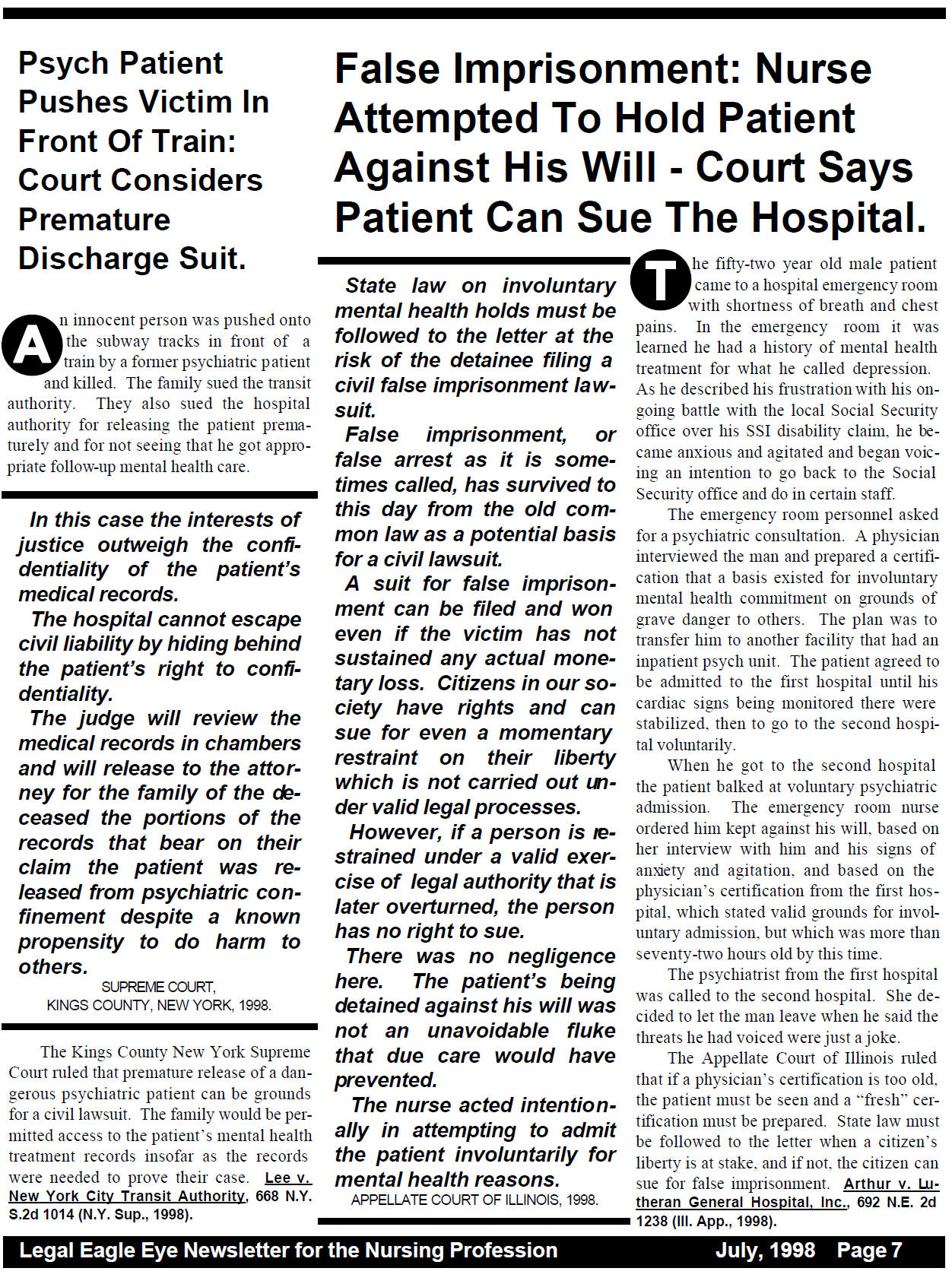
Quick Summary: The law on involuntary mental health holds must be followed to the letter at the risk of the patient filing a civil false imprisonment lawsuit.
False imprisonment, or false arrest as it is sometimes called, has survived to this day from the old common law as a potential basis for a civil lawsuit.
A suit for false imprisonment can be filed and won even if the victim has not sustained any actual monetary loss. Citizens in our society have rights and can sue for even a momentary restraint on their liberty which is not carried out under valid legal processes.
However, if a person is restrained under a valid exercise of legal authority that is later overturned, the person has no right to sue.
There was no negligence here. The patient's being detained against his will was not an unavoidable fluke that due care would have prevented.
The nurse acted intentionally in attempting to admit the patient involuntarily for mental health reasons. APPELLATE COURT OF ILLINOIS, 1998.
The fifty-two year old male patient came to a hospital emergency room with shortness of breath and chest pains. In the emergency room it was learned he had a history of mental health treatment for what he called depression. As he described his frustration with his on-going battle with the local Social Security office over his SSI disability claim, he became anxious and agitated and began voicing an intention to go back to the Social Security office and do in certain staff.The emergency room personnel asked for a psychiatric consultation. A physician interviewed the man and prepared a certification that a basis existed for involuntary mental health commitment on grounds of grave danger to others. The plan was to transfer him to another facility that had an inpatient psych unit. The patient agreed to be admitted to the first hospital until his cardiac signs being monitored there were stabilized, then to go to the second hospital voluntarily.
When he got to the second hospital the patient balked at voluntary psychiatric admission. The emergency room nurse ordered him kept against his will, based on her interview with him and his signs of anxiety and agitation, and based on the physician's certification from the first hospital, which stated valid grounds for involuntary admission, but which was more than seventy-two hours old by this time.
The psychiatrist from the first hospital was called to the second hospital. She decided to let the man leave when he said the threats he had voiced were just a joke.
The Appellate Court of Illinois ruled that if a physician's certification is too old, the patient must be seen and a fresh certification must be prepared. State law must be followed to the letter when a citizen's liberty is at stake, and if not, the citizen can sue for false imprisonment. Arthur v. Hospital, 692 N.E. 2d 1238 (Ill. App., 1998).